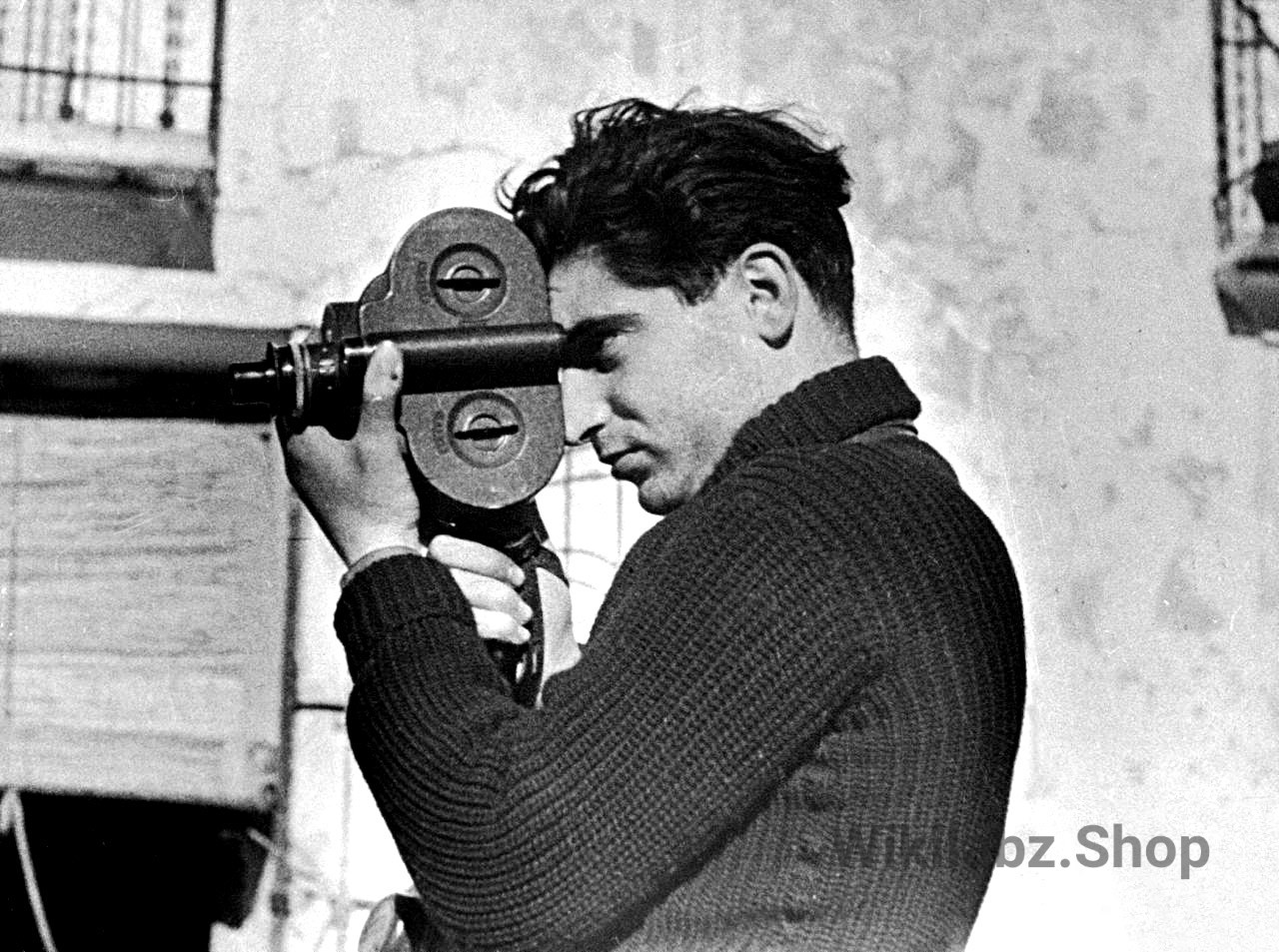
Introduction: The Greatest War Photographer in History
Robert Capa (born October 22, 1913 – died May 25, 1954) was a Hungarian-born American war photographer and photojournalist, widely considered the most important battle chronicler of the 20th century. In 2026, his legacy has reached a new fever pitch following the discovery of previously unseen footage showing him in action during the Liberation of Paris. His Wikipedia profile is currently the most visited historical biography today, as the world celebrates his mantra: “If your photographs aren’t good enough, you’re not close enough.”
Early Life and Real Name
His real name was Endre Ernő Friedmann. Born in Budapest, Hungary, he fled the country in 1931 due to his involvement in leftist political movements. He eventually landed in Paris, where he and his partner, Gerda Taro, invented the persona of “Robert Capa” a fictional, wealthy American photographer to sell their work for higher prices. This “invention” of himself is a key part of his 2026 search trend, as it highlights his early mastery of personal branding long before the social media era.
Career: Five Wars and One Legendary Agency
Capa’s career was defined by his presence at the front lines of five different conflicts: the Spanish Civil War, the Second Sino-Japanese War, World War II, the 1948 Arab-Israeli War, and the First Indochina War. He is most famous for his “Magnificent Eleven” photographs of the D-Day landings on Omaha Beach. In 1947, he co-founded Magnum Photos, the world’s first cooperative agency for freelance photographers, ensuring that creators retained the rights to their own images a principle that remains a cornerstone of the 2026 media landscape.
2026 Discovery: The Paris Liberation Footage
On February 18, 2026, a Paris museum unveiled a groundbreaking exhibition showcasing 24 rolls of film Capa took during the liberation of the French capital in 1944. More importantly, researchers used AI-enhanced technology to identify Capa in US Army footage from that same day. The world is searching for this 2026 update because it shows Capa not just as a name, but as a man dodging bullets on the rue Saint-Dominique with three cameras around his neck, proving he lived the danger he captured.
Tragic Death and Legacy
Robert Capa died as he lived on the front lines. On May 25, 1954, while covering the First Indochina War for Life magazine, he stepped on a landmine in Thái Bình. He was the first American correspondent killed in that conflict. His death cemented his status as a martyr for photojournalism. Today, his work is studied by every aspiring photographer, and his 2026 resurgence proves that his “unposed, immersed” style continues to define our perception of war and human resilience.
Quick Facts & Wiki Profile
- Real Name: Endre Ernő Friedmann
- Born: October 22, 1913 (Budapest, Hungary)
- Died: May 25, 1954 (Thái Bình, Indochina)
- Nationality: American (Hungarian-born)
- Key Achievement: Co-founder of Magnum Photos
- Most Famous Work: The Magnificent Eleven (D-Day)
- 2026 Status: Most Searched Historical Figure on February 18
Conclusion
The biography of Robert Capa is more than a list of dates; it is the story of how one man’s courage shaped the visual history of the world. As the 2026 Paris discoveries have shown, Capa remains a living influence on how we document truth in times of chaos. From inventing his own name to founding a global agency, his Wikipedia-worthy life continues to inspire millions. Robert Capa didn’t just take pictures; he gave the world eyes to see the cost of freedom.